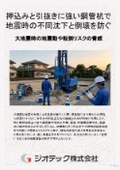
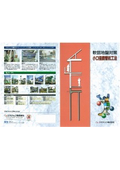
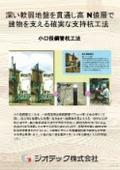
Seismic settlement prevention with small-diameter steel pipe piles | Ground reinforcement work compatible with pushing and pulling methods.
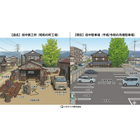
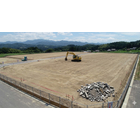
The small-diameter steel pipe piles with enlarged tips withstand bidirectional loads, thoroughly blocking the risks of differential settlement and overturning caused by major earthquakes and strong winds.
We propose a ground reinforcement solution using small-diameter steel pipe piles that maximizes seismic resistance against combined external forces such as seismic motion and wind loads. During large-scale earthquakes, structures on soft ground experience strong horizontal and uplift forces, creating a risk that traditional vertical load-bearing capacity alone cannot prevent differential settlement or overturning. This method features a special enlarged tip that ensures secure anchoring in the bearing layer, exhibiting extremely high resistance not only to compressive loads from above but also to uplift stresses during earthquakes. The construction can be carried out without disturbing the ground through cement-free rotary penetration, ensuring stable strength immediately after installation. With a clear support and uplift force calculation formula that has obtained public performance certification, advanced structural calculations focusing on disaster prevention are possible. At Geotech, we digitally record construction data throughout the entire process, providing clients with reliable quality and high seismic resistance based on this data.
basic information
This construction method is a rotary penetration pile method consisting of high-strength carbon steel pipes with an outer diameter of φ89.1mm to φ216.3mm and a tip expansion wing. The applicable range includes buildings with up to 3 stories, a height of up to 13m, and a total floor area of up to 1,500 square meters, as well as retaining walls and structures with a height of up to 3.5m. The maximum construction depth can accommodate up to 130 times the shaft diameter (up to a maximum of 19.2m, etc.) and is suitable for sandy and clayey soils. It has obtained architectural technical performance certification such as GBRC, and in addition to the allowable vertical bearing capacity in the pushing direction, a calculation formula for the allowable bearing capacity in the pulling direction has been established, making it a specification excellent in seismic design.
Price information
Delivery Time
Model number/Brand name
Ground reinforcement work
Applications/Examples of results
It is ideal for reinforcing the foundations of single-family homes, multi-family residences, medical and disaster response facilities, and stores to minimize the risks of shaking and differential settlement during major earthquakes. In particular, it is effective for three-story wooden houses that are prone to pulling forces from wind loads and seismic forces, high-rise buildings on narrow lots, tower structures, sign foundations, and construction near existing retaining walls. It is widely used in sites where reliable resistance in both pushing and pulling directions is required, as well as in architectural projects that demand high structural stability and objective evidence for building confirmation applications and ground guarantees.
catalog(3)
Download All Catalogs