Pure Pile Method | Ground Reinforcement Work
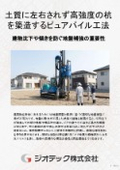
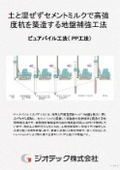
We propose the Pure Pile method, which forms pile-like reinforcement using high-strength cement milk without mixing local soil, eliminating soil quality effects and preventing differential settlement.
Ground evaluation and prevention of differential settlement are essential for building maintenance. GeoTech's Pure Pile method is a technique that expands the ground laterally with a conical excavation head and replaces it with high-strength cement milk to form pile-like reinforcement bodies. The main feature is that it does not mix the locally generated soil with cement, eliminating soil quality impacts even in diverse ground conditions such as humus layers, and consistently demonstrating high strength and quality as planned. By evenly distributing reinforcement bodies with a designed pile diameter of 20 cm, it supports building loads and eliminates settlement risks with high vertical bearing capacity. Additionally, since almost no residual soil is generated, disposal costs and site burdens can be reduced. At GeoTech, under an ISO-certified quality management system, specialized technicians measure and manage data in real-time, providing safe and reliable construction.
basic information
The design pile diameter of this construction method is a uniform specification of 20 cm, and it can accommodate a maximum construction depth of up to 10 m from the construction ground surface. The applicable ground types are sandy soil, clayey soil, and humus soil. The applicable buildings are small-scale structures such as single-family houses with three stories or fewer, a height of 13 m or less, an eaves height of 9 m or less, and a total floor area of 1500 square meters or less, as well as ground slabs. This technology has obtained a construction technology performance certification from the General Incorporated Foundation Japan Building Comprehensive Testing Institute (GBRC Performance Certification No. 11-28). With a pile structure that uses 100% cement milk without mixing with local soil, it boasts high quality stability and suppresses the discharge of excavated soil on-site through the use of straight rods.
Price information
Delivery Time
Model number/Brand name
Ground reinforcement work
Applications/Examples of results
It is primarily used for ground subsidence measures and foundation reinforcement in buildings such as wooden, steel frame, and reinforced concrete single-family homes, multi-family residences, and small-scale stores. It is particularly suitable for ground measures in soft ground with distributed humus layers and in special soil types where poor solidification tends to occur due to mixing with local soil. Furthermore, it is widely adopted in sites that require measures to prevent subsidence of floor slabs in factories and warehouses, as well as in projects where there is a desire to significantly reduce the amount of construction waste generated. It contributes to practical applications as a safe and reliable ground reinforcement solution in the foundation design of small-scale buildings, where certain vertical bearing capacity and high quality stability are required.
catalog(3)
Download All Catalogs