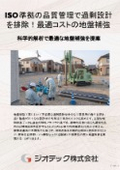
Ground reinforcement | Geo-column method prevents excessive design with ISO quality management.
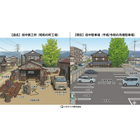
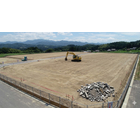
Elimination of excessive design with ISO 9001 compliant QMS. The geocore method ensures support strength and cost optimization through objective data.
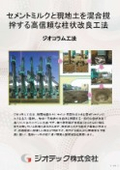
In ground reinforcement work, achieving both reliability and cost efficiency requires strict quality control and design based on scientific evidence. The Geo-Column method is a technique that mechanically mixes locally generated soil with cement slurry to construct strong soil-cement column improvements underground. Geotech Co., Ltd. has established a Quality Management System (QMS) based on ISO 9001, managing the entire process from ground investigation and analysis to design, site arrangements, and final inspections with high transparency. During construction, a dedicated automatic measurement device records excavation depth, rotation torque, and slurry discharge volume in real-time, visualizing and proving the quality of underground structures numerically. This approach eliminates excessive design while ensuring reliable support performance over the long term, providing clients with peace of mind and rational solutions.
basic information
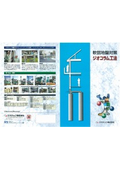
The design specifications for the geo-column method specify a standard cross-sectional area of 0.283m² (φ600mm), with applicable ground conditions being cohesive soil (settling into good ground with an N value exceeding 3) and sandy soil (settling into good ground with an N value exceeding 4). The design strength standard Fc is set between 400 and 1,500 kN/m² (with 600 to 800 kN/m² set for general single-family homes). The standard amount of solidifying agent added is 300 kg/m³ or more for cohesive soil, 250 kg/m³ or more for sandy soil, and 350 kg/m³ or more for organic soil, with strict adherence to management standards compliant with ISO 9001 (measurement error within ±2%, management of water slurry specific gravity).
Price information
Delivery Time
Model number/Brand name
Ground reinforcement work
Applications/Examples of results
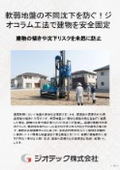
It is widely used for the foundation ground reinforcement of single-family homes, multi-family residences, and apartments, where reliable structural evidence and budget optimization are required. It is applied directly beneath strip foundations (with a standard column pitch of 910mm) and slab foundations (with average placement and concentrated placement under load-bearing walls), preventing eccentricity and settlement due to uneven building loads. Additionally, it is utilized as a standard construction method by design offices and construction companies that want to avoid excessive design, reinforcing areas such as exterior corners, interior corners, through columns, and the lower parts of entrance porch columns. It is ideal for sites that require reliable quality control based on substantiated numerical data.
catalog(4)
Download All Catalogs