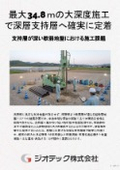
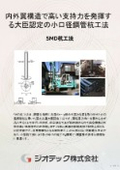
Maximum 34.8m grounding | SMD ground reinforcement method with a shaft diameter of 130 times reduction
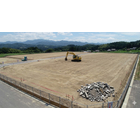
A shaft diameter of 130 times and a maximum deep penetration of 34.8 meters for reliable anchoring to the support layer. Minister-approved SMD method.
Reliable foundation reaching deep support layers in extremely soft ground. SMD piles are small-diameter rotary driven steel pipe piles certified by the Minister of Land, Infrastructure, Transport and Tourism, with a cutting force of 130 times the shaft diameter (up to 34.8 m). The steel pipe tips, ranging from φ89.1 mm to φ267.4 mm, are equipped with internal and external wings, allowing for straight penetration through thick soft layers without deviation. When reaching target layers with an N value of 60 or below (sandy soil) or 27 or below (clay), the internal blockage effect provides tremendous end bearing capacity. Torque and depth are automatically recorded with a dedicated device, demonstrating deep foundation reliability with objective data. Strict management ensures safety under challenging conditions.
basic information
The SMD method is a rotation-driven steel pipe pile construction method certified by the Minister of Land, Infrastructure, Transport and Tourism, capable of covering a maximum installation depth of 34.8 meters (130 times the shaft diameter) (TACP-0112/0113, etc.). It consists of STK400/490 steel pipes with shaft diameters ranging from φ89.1 mm to φ267.4 mm, and special wings that are 2 to 3 times the outer diameter. It has clear evaluation criteria based on the N value of standard penetration tests and is suitable for deep supporting layers in sandy soil (equivalent N value of 60 or less) and clayey soil (equivalent N value of 27 or less). It is a public specification that ensures reliable bearing capacity even at great depths.
Price information
Delivery Time
Model number/Brand name
Ground reinforcement work
Applications/Examples of results
The SMD method is optimal for construction reinforcement work in areas with soft layers that exist at depths of 15 to over 30 meters below the surface, such as coastal areas, river basins, and reclaimed land. It is utilized in deep support sites where surface improvement or soil columns are not feasible, as well as in mid-rise steel frame buildings, apartment complexes, and the foundation reinforcement of large billboards and retaining walls that require high anchorage loads. It is chosen for sites where there is a desire to ensure reliable anchorage to great depths based on clear calculation grounds and to physically prevent uneven settlement of structures.
catalog(3)
Download All Catalogs