Factory energy storage container uneven load settlement countermeasures | Ground evaluation
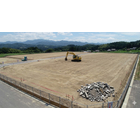
Avoiding the risk of uneven loading settlement in battery storage containers. Measuring the ground reaction coefficient through plate loading tests to eliminate excessive reinforcement and optimize foundation costs.
As the introduction of container-type storage batteries for decarbonization and disaster prevention purposes expands, uneven loading due to equipment placement bias poses serious risks such as foundation tilting and differential settlement. Geotech's ground bearing capacity evaluation conducts plate load tests directly beneath the installation site to accurately calculate the ultimate bearing capacity, deformation coefficient, and ground reaction coefficient (K value) of shallow ground. By eliminating unnecessary deep ground improvement and piling based on reliable mechanical evidence rather than estimates, we can transition to direct foundations such as mat foundations, achieving significant cost reductions in construction and minimizing excess soil, thus aligning with ESG goals. Strict quality control by qualified personnel and verification against our in-house database "GEODAS" also enable rapid responses to structural conformity assessments and building confirmation applications. We provide comprehensive support for the optimal construction of storage foundations that balance safety and economic efficiency.
basic information
This test will be conducted in accordance with the Geotechnical Engineering Society Standard JGS1521 "Method for Plate Load Test on Ground," by placing a steel loading plate (diameter 300mm) on the prepared ground up to the foundation installation depth. A reaction frame and hydraulic jack will be used to perform five cycles of multi-stage loading, and the immediate settlement and load retention behavior will be automatically and continuously recorded in millimeter units using a high-precision displacement gauge. From the obtained P-S curve (load-settlement relationship), the ultimate bearing capacity, long-term and short-term allowable bearing capacities, ground reaction coefficient Kv value, and deformation coefficient E0 value will be calculated. Measurement equipment that has been inspected before each site and calibrated annually will be used, and the analysis and reporting will be completed by an in-house ISO 9001 qualified personnel.
Price range
Delivery Time
Model number/Brand name
Boring survey
Applications/Examples of results
It is directly used for evaluating ground bearing capacity and diagnosing uneven load and differential settlement in the installation of container-type stationary storage battery systems on factory and business site premises. It is particularly suitable for the actual measurement of ground bearing capacity in battery yards where heavy equipment is unevenly distributed, checking the allowable ground pressure for substations, generators, and high-voltage transformer foundations, as well as for second opinion assessments aimed at reducing excessive piling work and deep ground improvement. It supports the safety construction of self-consumption type storage battery facilities by confirming ground stability procedures when renovating existing factory parking lots or material storage areas into storage battery sections, and by preparing structural design basis documents for building confirmation applications.
catalog(3)
Download All Catalogs