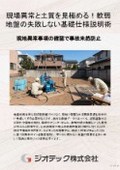
Site Investigation | Optimize Foundation Specifications through Anomaly and Soil Type Identification
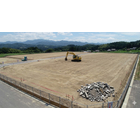
Conduct precise analysis of local anomalies and soil quality to eliminate differential settlement risks. Achieve both client satisfaction and safety with assessments from qualified professionals.
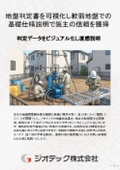
Differential settlement caused by misjudgment of soft ground or embankment construction is a serious issue that threatens the lives of homeowners and undermines the credibility of builders. Relying solely on numerical data can lead to overlooking site anomalies such as retaining wall cracks and road subsidence, as well as special soil types like Kanto loam, high-water-content clay, and humus soil, resulting in inappropriate foundation selection. This document explains how to accurately understand site anomalies and soil structure, and effectively communicate risks and countermeasures. Geotech conducts environmental surveys by site supervisors and multifaceted analyses by residential foundation specialists and geological survey technicians. We issue substantiated assessment reports through a strict process compliant with ISO 9001 and provide ground guarantees of up to 50 million yen. By presenting assured safety, we alleviate homeowners' concerns and support the establishment of long-term trust.
basic information
This document specifies the checklist items from the on-site survey (such as cracks in retaining walls, exterior walls, and foundations, tilting of utility poles, and road subsidence) and the specifications and standards based on soil classification techniques from various ground investigation tests (such as SWS tests, hand augers, SDS tests, and boring tests). It outlines the evaluation procedures for cohesion and friction angles for each soil type classification (clay, sandy soil, gravelly soil, humus soil, and loam), the ground assessment flow based on QMS (including the assessment of elements like artificial obstacles, retaining walls, and embankments), as well as the standards for manual review and evidence management conducted by qualified personnel under the ISO 9001 certification process.
Price range
Delivery Time
Model number/Brand name
Boring survey
Applications/Examples of results
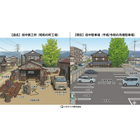
It can be utilized for foundation planning of wooden and steel-structured houses in areas with uneven ground due to embankment construction with elevation differences, properties near retaining walls, uneven ground after the demolition of existing buildings, and regions with special soil distribution. It is ideal for establishing a quality management system that anticipates potential risks from abnormal site conditions and for obtaining technical backing to prevent differential settlement accidents caused by misjudgments. It can be used as a risk communication tool for residential builders and designers to explain the basis of safety and the validity of foundation specifications to clients, as well as a practical tool to eliminate unnecessary ground reinforcement proposals and gain customer trust.
catalog(3)
Download All Catalogs