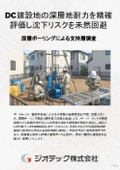
DC site investigation: Zeroing out settlement risk through deep foundation capacity evaluation.
Conduct a precise evaluation of the deep soil bearing capacity at the DC construction site and preemptively avoid settlement risks due to ultra-high loads through consolidation analysis.
In the construction of ultra-high load facilities such as data centers, understanding the bearing capacity of deep ground and preventing long-term settlement are essential. Our ground investigation services precisely measure the N-value distribution of the supporting layer through deep boring and standard penetration tests. Furthermore, we identify the compression index and over-consolidation ratio through laboratory consolidation tests using undisturbed samples of cohesive soil, allowing us to quantitatively predict future consolidation settlement amounts and convergence timing. We also calculate the ground deformation coefficient through in-situ horizontal loading tests and conduct multi-faceted stratigraphic analysis using our proprietary database "GEODAS." With reliable evaluations based on measured data and technical foundations, we strongly support the smoothness of building confirmation reviews and the long-term safe operation of data centers.
basic information
This survey consists of deep drilling using a deep drilling machine and standard penetration tests (N-value measurements) in accordance with JIS standards. For cohesive soil layers, undisturbed sample collection is conducted using tools such as a triple tube sampler, and the consolidation yield stress, compression index, and consolidation coefficient are calculated through the JIS A 1217 staged loading consolidation test. Additionally, the lateral deformation coefficient of the ground is measured through in-situ lateral loading tests (LLT). The acquired data is cross-verified with the company's ground information system GEODAS and compiled into an analysis report as highly reliable ground parameters.
Price range
Delivery Time
Model number/Brand name
Boring survey
Applications/Examples of results
It is ideal for the foundation structural design and long-term allowable bearing capacity verification in new construction and expansion plans for data centers and ultra-high-load server buildings. It can be used for quantitative assessment of micro-settlement and differential settlement risks in facilities where precision equipment and high-density racks are installed, as well as for the selection and judgment of pile foundations and shallow foundations. Additionally, it can be widely utilized for presenting reliable load-bearing evidence in building confirmation applications and structural conformity assessments, as well as for planning ground risk prevention measures with a view to the lifecycle of large industrial facilities.