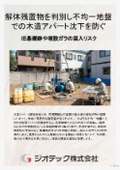
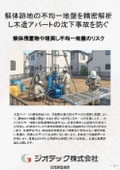
Wooden apartment demolition site | Subsurface remnants and uneven ground SW analysis
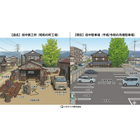
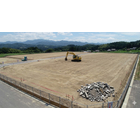
Quantitative visualization of residual materials and strength differences in SW testing. We structurally eliminate the risk of differential settlement in wooden apartments without relying on traditional assumptions.
At the demolition site, the strength dispersion caused by the old foundation and insufficient backfill is the root cause of distortion accidents after new construction. This method precisely measures depth-specific resistance values through multi-point SW testing, accurately restoring the geological cross-section while eliminating the influence of obstacles. By comparing measurement points and simulating estimated deformation angles, we quantitatively calculate differential settlement behavior. We present reinforcement plans optimally suited to the ground conditions, such as surface improvement, columnar improvement, and small-diameter steel pipe pile methods, ensuring high-quality evidence.
basic information
This survey method is based on the screw weight penetration test (SWS test) and, as necessary, also employs hand augers and boring surveys. The applicable depth can accommodate up to a maximum of 10 meters below the foundation, and penetration load and half-rotation counts are recorded precisely. In data analysis, the Inada method for converting N values is applied, and allowable bearing capacity calculations are performed according to the soil characteristics of cohesive soils and sandy soils, respectively. Furthermore, a multifaceted assessment is conducted based on a unique three-item, eight-element criterion (strength, shrinkage, deformation, etc.), and a detailed ground investigation report, including elevation measurement data, is prepared and issued.
Price range
Delivery Time
Model number/Brand name
Boring survey
Applications/Examples of results
It is mainly used for new construction and rebuilding projects on the sites of demolished wooden apartments and houses, as well as on uneven ground after the removal of old structures. It is ideal for accurately assessing localized softening and settlement risks caused by leftover demolition debris and uneven backfill soil on the site. It is used as a basis for design when determining the suitability of direct foundations such as slab foundations and strip foundations, as well as for ground reinforcement work such as surface improvement, columnar improvement, and small-diameter steel pipe piles. It is also widely used as attached documents for building confirmation applications and as quality certification evidence for ground warranty organizations.
catalog(3)
Download All Catalogs