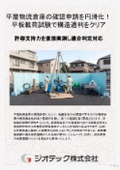
Measures against ground unevenness in single-story logistics warehouses | Foundation assessment through plate load testing
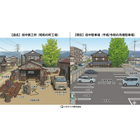
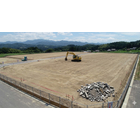
Clarifying the ground unevenness of a vast single-story logistics warehouse! Conducting plate load tests to evaluate soil bearing capacity by area and achieving pinpoint foundation design.
In the planning of a single-story logistics warehouse with a vast site, precise understanding of ground strength variability (ground inconsistency) is key to cost control. Relying solely on weak points at measurement locations to implement deep pile work or ground improvement across the entire site can lead to excessive foundation construction costs. Geotech's plate load testing solution applies direct loads at multiple locations on large areas, accurately measuring the ultimate bearing capacity and deformation coefficients of the foundation bearing surface. It quantifies the allowable bearing capacity by area, allowing for the application of "direct foundations (such as mat foundations or strip foundations)" in sufficiently strong areas, while enabling "pinpoint foundation design" that reinforces only the weak localized areas. Additionally, through deformation angle analysis, it scientifically demonstrates the prevention of differential settlement, ensuring structural safety while minimizing excessive reinforcement costs.
basic information
The testing work will be conducted in accordance with the Geotechnical Engineering Society Standards (JGS 1521), and a reaction device such as a hydraulic backhoe that conforms to the planned load, along with a steel loading plate with a diameter of 30 cm, will be installed. A high-precision compression load cell will be incorporated into the multi-stage loading system using hydraulic jacks, and for displacement measurement, a digital displacement gauge (such as CDP-50) with a resolution of 1/100 mm and a self-recording data logger will be used. Thorough daily inspections of the equipment and leveling checks of the magnetic stands will be carried out before the work, and the ultimate bearing capacity, long-term allowable bearing capacity, and deformation coefficients for each area will be accurately calculated from the measured settlement-load curves.
Price information
Please contact us.
Delivery Time
Model number/Brand name
Ground investigation
Applications/Examples of results
The newly constructed single-story logistics warehouse, large distribution center, and large factory within an industrial park on a large area of land are ideal for examining foundational structures. If you want to visualize the uneven bearing capacity of the ground on the site and avoid uniform reinforcement across the entire area, it helps in making decisions to apply direct foundations (slab foundations or strip foundations) to areas with sufficient strength and in planning significant construction cost reduction measures focused on localized reinforcement. Additionally, it is widely used in the planning stages of large-scale developments for attaching structural calculation documents with deformation angle analysis data to prevent differential settlement and for proposing optimal foundation layouts to general contractors and design offices.
catalog(3)
Download All Catalogs