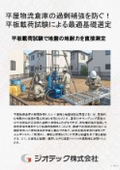
Logistics warehouse floor slab | Prevention of excessive reinforcement and foundation assessment through plate loading tests.

Eliminate the risk of floor subsidence in logistics warehouses! Measure shallow soil bearing capacity through plate load tests and achieve optimal foundations compatible with AGVs and heavy machinery.
When constructing a single-story logistics warehouse, concerns about floor sinking due to the operation of high-rise racks, AGVs, and forklifts often lead to excessive ground reinforcement. GeoTech's plate load test is a solution that places a rigid loading plate on the shallow ground directly beneath the foundation and applies a direct load to accurately measure the original ultimate bearing capacity and deformation coefficient of the ground. By eliminating underestimations based on assumptions and calculating the precise long-term allowable bearing capacity, it enables the adoption of "direct foundations" or "minimal shallow reinforcement," avoiding pile work and excessive ground improvement. Furthermore, through the quantitative visualization of sinking behavior under staged loading, we scientifically demonstrate the structural safety of the floor capable of withstanding continuous heavy loads. Utilizing GeoTech's reliable site management technology and extensive ground database, we support the construction of ideal logistics warehouses that balance reduced construction costs with high floor quality.
basic information
In accordance with the Geotechnical Engineering Society standard JGS 1521, we will implement staged loading using reaction heavy machinery (such as backhoes) and a rigid loading plate (30 cm in diameter) based on the design load at the site. For load measurement, we will use high-precision load cells (compression load gauges), and for displacement measurement, we will use digital displacement gauges (such as CDP-50) with a resolution of 1/100 mm, automatically recording settlement behavior with a self-recording device. We will thoroughly calibrate and inspect the equipment beforehand, as well as level the magnetic stands, and accurately calculate the ultimate bearing capacity, long-term allowable bearing capacity, and deformation coefficient from the obtained P-S curve to create a highly reliable analysis report.
Price range
Delivery Time
Model number/Brand name
Ground investigation
Applications/Examples of results
It is optimal for selecting the best foundation types (such as strip foundations and mat foundations) and evaluating ground bearing capacity in new construction plans for single-story logistics warehouses and distribution centers. It can be used to reduce costs associated with excessive piling and deep ground improvement, verify the support capacity of the floor slab where automated guided vehicles (AGVs) and heavy forklifts operate, and devise measures to prevent floor surface inclinations and cracks. Additionally, it can be utilized for second opinion evaluations on unnecessary ground reinforcement proposals, attaching supporting data to structural calculation documents, and providing technical justifications for confirmation applications and to clients and general contractors throughout a wide range of processes from planning to design.
catalog(3)
Download All Catalogs