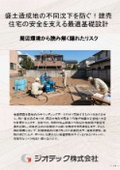
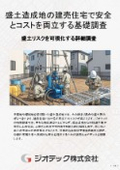
Soil investigation for residential land development | Safety and cost optimization
Analyze the risk of differential settlement in fill soil areas through geological and environmental assessments. Implement optimal foundation design that eliminates waste.
In the case of subdivided built houses on filled land, there are concerns about the risk of differential settlement due to variations in soil bearing capacity and the influence of retaining walls. Geotech goes beyond mere numerical measurements to conduct a comprehensive risk assessment that includes terrain classification, preliminary surveys of land history, and verification of deformations in neighboring houses and retaining walls. Vulnerabilities such as insufficient compaction and uneven fill are identified in three dimensions through SWS testing and elevation surveys. Our specialized staff analyzes complex data from multiple perspectives to calculate the true soil bearing capacity. This prevents overestimation and reduces unnecessary reinforcement, achieving optimal foundation design that balances profit and safety.
basic information
Based on the measurement of static penetration resistance using an SWS testing machine, N-value conversion data will be obtained at multiple points within the site. In addition, a historical survey using past aerial photographs and topographic maps, as well as on-site level surveying (to confirm elevation differences) and visual inspections of the surrounding conditions (to check for abnormalities such as foundation cracks and wall inclinations) will be conducted in parallel. The collected data will be subjected to specialized analysis programs for settlement calculations based on the guidelines for small-scale building foundation design and evaluations of bearing capacity by soil type, and ultimately, a qualified analyst will make a comprehensive judgment taking into account the specific characteristics of each property.
Price range
Delivery Time
Model number/Brand name
Ground investigation
Applications/Examples of results
It is ideal for ground surveys of newly developed residential areas that have been extensively constructed in mountainous regions and on sloped terrains, as well as for built-for-sale houses in subdivided lands with elevation differences. It demonstrates its effectiveness in sites where there are strong concerns about the risk of differential settlement due to uneven ground, such as those with a mix of cut and fill, or plans to place buildings close to high retaining walls. By meticulously uncovering hidden ground risks, it helps prevent claims and repair costs after handover due to ground accidents, while also reducing unnecessary excessive ground improvement work, thereby facilitating decision-making to complete subdivision projects safely and at appropriate costs.
catalog(3)
Download All Catalogs