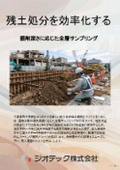
Cost Reduction for Soil Disposal | Analysis Method for Compliance with Municipal Regulations
Significantly reduce the cost of soil disposal. Achieve zero delays on site with rapid removal through specification verification and sampling optimization.
The refusal of excess soil and delays in disposal at construction sites pose a serious management risk that undermines project profitability. This document provides an optimized analytical method to fundamentally resolve such issues faced by clients and general contractors. To eliminate the risk of work stoppage, we have systematized thorough procedures for pre-specification verification and developed comprehensive sampling techniques for different excavation depths in accordance with strict regulations set by Chiba Prefecture and others. Additionally, we have fully packaged measures for site-specific items outside legal standards, such as oil content and dioxins. In response to the unique rule of "prohibition of reuse of existing data" in public works in Tokyo, we seamlessly guide the new registration process for each target lot, ensuring zero procedural deficiencies. By utilizing high-precision official analytical techniques and specialized terminology, we guarantee reliable disposal without rejections and adherence to construction timelines.
basic information
This is a chemical analysis service that complies with the soil disposal regulations of various local governments (such as Chiba Prefecture) and the specifications of private acceptance sites. Sampling is conducted in accordance with the maximum excavation depth, utilizing vertical full-layer and equal-volume mixing sampling, and completely prevents secondary contamination of cores through anhydrous excavation methods (rotary and impact penetration drilling). The analysis covers a wide range of items, including 26 specific hazardous substances, as well as site-specific oil content, dioxins, and soil tests (such as particle size analysis and cone index). We issue official measurement certificates based on the Measurement Act in the shortest possible time and have the capability to create individual registration documentation and data linkage for public works and urban projects where the reuse of data from other sites is not permitted.
Price information
Price range
P3
Delivery Time
P4
Model number/Brand name
Soil survey
Applications/Examples of results
This will be introduced to prevent acceptance refusal troubles and to establish early transportation routes for the large amounts of construction residual soil generated from underground excavation, basement demolition, and pile foundation work in the rebuilding of buildings, factories, and residential homes. It is optimal for developing a comprehensive sampling plan linked to the maximum excavation depth to comply with strict residual soil regulations, such as those in Chiba Prefecture, and for the prior identification of additional analysis items required by acceptance disposal sites, such as oil content and dioxins. Particularly in public works where the reuse of data from other sites is prohibited, it will be utilized to quickly obtain lot-specific weight certificates, facilitating smooth registration practices and passing procedural reviews.