Bamboo Damage Countermeasure "Take Guard Method" 7-Year Case Study


We will introduce a case study of the 'Take Guard Method,' which suppresses bamboo growth using a special sheet and dedicated pins, after 7 years.
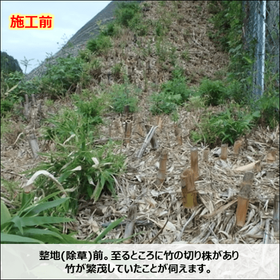
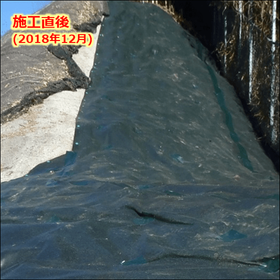
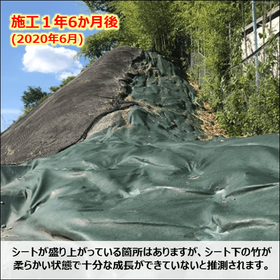
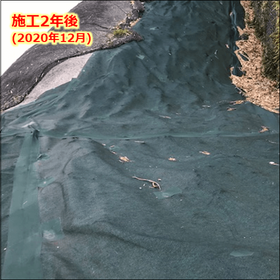
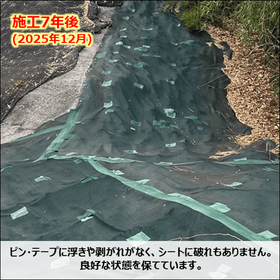
The "Take Guard Method" is a technique for suppressing the growth of bamboo, which was released in 2022 after three years of development. We would like to introduce the state of the site where our technology development department has been conducting tests since before the launch of the "Take Guard Method." ★ The site introduced this time differs in some auxiliary materials from the current "Take Guard Method" due to it being a test installation. The sheet is the same as the current Take Guard sheet. <Image 1> A photo of the site before leveling, which has not been weeded. There are stumps everywhere from cut bamboo, indicating that bamboo had been flourishing. <Image 2> A photo taken immediately after the test installation. (The fixing pins and adhesive tape differ from the current "Take Guard Method.") <Image 3> A photo of the site 1 year and 6 months later. Some areas of the sheet are raised, but they feel soft when stepped on, suggesting that bamboo has not been able to grow sufficiently underneath the sheet. The growth of bamboo is being suppressed. <Image 4> A photo of the site 2 years later. There are no lifts or peeling of the fixing pins or tape, and it is maintaining a good condition. <Image 5> A photo of the site 7 years later. There are no lifts or peeling of the fixing pins or tape, and the sheet is not torn. It is maintaining a good condition.
basic information
【Features】 * Easy to install with a special sheet and dedicated pins * Effectively suppresses bamboo growth * Long-term effects can be expected * NETIS registered product
Price range
Delivery Time
Applications/Examples of results
For more details, please refer to the PDF document or feel free to contact us.
catalog(3)
Download All Catalogs


Distributors

The Hakuzaki Corporation is committed to "controlling weeds with environmentally friendly methods and cultivating only the desired plants," providing "weed-free excitement, the best in Japan." In other words, the above-ground parts of the plants are protected from weed pressure with mulching materials, while the underground parts are supported by symbiotic microbial materials that assist root activity.