
news list
1~7 item / All 7 items
-
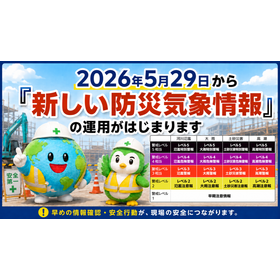
The operation of "New Disaster Prevention Weather Information" will begin on Friday, May 29, 2026.
According to the Japan Meteorological Agency, the operation of the "New Disaster Prevention Weather Information" will begin on Friday, May 29, 2026. The new disaster prevention weather information will organize four types of disasters—river flooding, heavy rain, landslides, and storm surges—into five levels of alert (1 to 5) and standardize the names to clarify the criteria for evacuation decisions. Regarding the timing of the switch, the Japan Meteorological Agency will carry out the transition work starting at 1 PM on Thursday, May 28, the day before the operation begins. If any issues arise, they will revert to the previous specifications and conduct the transition work at a later date. The services provided by Sysmet Co., Ltd. will also respond to the new disaster prevention weather information, but depending on the progress of the Japan Meteorological Agency's system transition, there may be a possibility of delays in updating our services. This article will explain how the new disaster prevention weather information will change. 1. Current issues with disaster prevention weather information 2. How the new disaster prevention weather information will change 3. Timing of the switch 4. Are you able to share information about disaster prevention weather information? For more details, please visit our website.
-

From June 1st, measures against heat stroke in the workplace will be mandatory! Are you prepared?
In light of the recent increase in heatstroke-related fatalities due to extreme heat, the Ministry of Health, Labour and Welfare has announced that it will amend the Occupational Safety and Health Regulations, which will take effect on June 1, 2025. This article provides a brief overview of "what measures will be necessary." Table of Contents 1. The Importance of Initial Response 2. Measures to be Taken by Employers (1) Establishment of a System (2) Creation of Implementation Procedures (3) Awareness Raising Among Stakeholders 3. Efficient Heatstroke Measures Using Chat Tools and Centralized Management Tools *For more details, please visit our website or feel free to contact us.
-

[Weather Useful Information] Can satellite images show the strength of cold air above? What is "offshore distance"? Supervised by Sysmet Co., Ltd. Weather Forecaster.
Thank you for always watching. The last weather-related information for 2024 will introduce a theme unique to winter. As December has arrived, the temperature has dropped significantly. During this time, the term "cold air aloft" is often heard in weather forecasts. The phenomena of cold air aloft and clouds observed by the Himawari weather satellite can be viewed as images on the Japan Meteorological Agency's website. In fact, those images contain indicators that suggest the strength of the cold air aloft, in addition to the movement and shape of the clouds. This is referred to as "offshore distance." This time, I would like to introduce this "offshore distance." It may sound like a difficult term that is not very familiar, but it can actually be easily checked. Table of Contents 1. What is offshore distance? 2. Offshore distance and the strength of cold air aloft 3. Conclusion *For more details, please visit our website or feel free to contact us.
-
[For Civil Engineering and Construction Supervisors] Setting Standards for Work Suspension Due to Bad Weather on Construction Sites
In the construction industry, "bad weather" such as heavy rain and typhoons is one of the threats that jeopardizes the safety of workers and the work plan at the site. According to the Labor Safety and Health Act, (Prohibition of Work During Bad Weather) Article 522 When a business operator conducts work at a height of 2 meters or more, if there is a forecast of danger due to bad weather such as strong winds, heavy rain, or heavy snow, they must not engage workers in that work. However, even though "bad weather" can be described in one word, perceptions of it vary from person to person. Therefore, site supervisors need to establish specific numerical values or indicators to define what constitutes "bad weather" and set criteria for halting work, ensuring that all parties involved have the same understanding. So, how should these criteria be established? Table of Contents 1. What is the specific definition of "bad weather"? 2. Examples of work affected by rain and strong winds 3. Considerations for setting work stoppage criteria 4. Let's understand the weather information at the work site! *For more details, please visit our website or feel free to contact us.
-
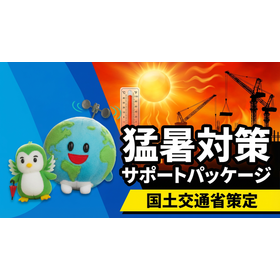
A support package for measures against extreme heat in construction work has been established!
― System development to prevent leaving extreme heat to "on-site discretion" is gaining momentum ― In recent years, the intensity of summer heat has been increasing, and it is now recognized as a risk that is not just temporary but becoming a norm. On December 23, 2025, the Ministry of Land, Infrastructure, Transport and Tourism formulated a "Heat Wave Countermeasure Support Package for Construction Works," which respects the autonomy of contractors while supporting the use of the latest technologies and diverse working styles. This article will clearly explain what has changed with the formulation of this package and how it can be utilized. For more details, please visit our website.
-
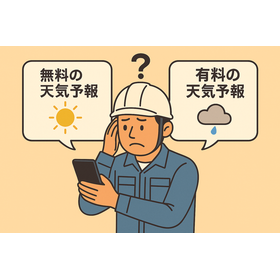
The meaning of utilizing paid weather forecasts.
Thank you for always watching us. Currently, there are many weather forecasting services and free apps available. The accuracy of predictions has also improved, and there are likely many people who find that free weather forecasts are sufficient for their daily lives. Sysmet Co., Ltd. provides various weather information services for a fee as a weather company. One of these is the "Natural Disaster Prevention System ZEROSAI," which is utilized for weather measures in civil engineering and construction projects. This time, we will introduce the differences between ZEROSAI and free weather forecasts, as well as the strengths of ZEROSAI. *For more details, please visit our website or feel free to contact us.
-

[Weather Helpful Information] What to do after a disaster occurs!? Are you familiar with the timeline (disaster prevention action plan)?
Thank you for always watching. In recent years, abnormal weather has been increasing, and disasters caused by heavy rain and typhoons are unavoidable. However, anticipating "how to act" and "what measures to take" in advance greatly influences whether damage can be minimized. This time, we will introduce a "Timeline (Disaster Prevention Action Plan)" that anticipates and plans "how to act" and "what measures to take" in chronological order, as well as an automatic notification service that links business chat with weather forecasts from Sysmet. Table of Contents 1. What is a "Timeline (Disaster Prevention Action Plan)"? 2. Image of the "Timeline (Disaster Prevention Action Plan)" 3. Let's automatically notify weather information through business chat *For more details, please visit our website or feel free to contact us.