
news list
latest news
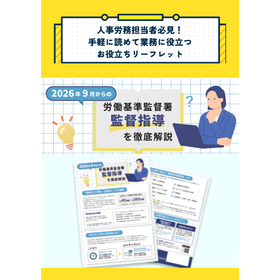
Starting from September 2026, the Labor Standards Inspection Office will implement uniform guidance to reduce overtime to within 45 hours per month. A flyer summarizing the key points of the changes and future business review points is being distributed for free.
Starting from September 2026, the uniform reduction guidance of "overtime within 45 hours per month" by the Labor Standards Inspection Office has been revised. What specifically has changed with thi…
1~7 item / All 7 items
-
Why was that company able to reduce the burden of attendance management? Six successful implementation examples of Universal Kinjiro.
Many companies have achieved improvements in business challenges through the introduction of Universal Kinjiro! Here, we present some case studies. 1. Manufacturing Industry Phiten Corporation Concern: Want to respond flexibly to system changes After Implementation: Increased flexibility in settings due to legal revisions and changes in employment regulations! 2. Information and Communication Industry Miroku Information Service Co., Ltd. Concern: Want to reduce labor risks After Implementation: Both employees and managers can easily check work conditions. 3. Retail and Wholesale Industry Hello Day Co., Ltd. Concern: Shift creation is complicated After Implementation: The number of shift patterns reduced dramatically from over 5000 to just 10! 4. Medical and Welfare Industry Yujikai Medical Corporation, Sasaki Hospital Concern: Many manual tasks After Implementation: Able to move away from paper and Excel-based management. 5. Construction Industry Takaya Co., Ltd. Concern: System operation is complicated After Implementation: Reduced inquiries from employees with intuitive screen operations! 6. Transportation Industry Donan Isaribi Railway Co., Ltd. Concern: Complex work patterns After Implementation: Flexible response to 24-hour shifts and rotating shifts became possible. We are currently publishing detailed materials introducing each case study. Please take a look!
-
[Free Distribution] Required after July 2026! Distributing the latest materials useful for HR, labor, and accounting personnel. Checklist for confirming legal revisions and system changes.
We have compiled a checklist of major legal revisions and system changes related to personnel, labor, and accounting operations effective from July 2026 onwards. The checklist includes items that will be useful for future preparations, such as the increase in the statutory employment rate for persons with disabilities, measures against customer harassment, the expansion of social insurance coverage, and the inspection of attendance data in light of the review of labor standards law. You can easily check off items to see at a glance what has not yet been addressed and what has been completed. Additionally, for systems that have already been implemented, we have included an "Operational Confirmation Checklist" to verify whether regulation revisions, payroll calculations, internal communication, and inquiry responses are being effectively operated. This checklist is available for free download and can be used immediately. We encourage you to utilize it to prevent any oversights in responding to legal revisions and to organize your internal preparation status. Furthermore, our company provides a system that strongly supports compliance with laws and regulations for businesses and organizations. Please also check our Universal Kinjiro series products.
-
[Dialogue] A special discussion with Professor Akihito Shimazu from Keio University is now available! Why do companies with high work engagement grow? We will discuss the correlation between work intervals and stress.
Kinjirō Co., Ltd. and Professor Akihito Shimazu from Keio University’s Faculty of Policy Management held a discussion on the themes of health management and improving work engagement. Please download it and utilize it for your business. 【Recommended for those facing the following issues】 - Business owners and HR personnel looking for specific methods and evaluation indicators to promote health management and human capital disclosure. - Those who want to enhance work engagement and loyalty within the company and invigorate the organization. - Those who want to understand the effects of implementing a work interval system and the scientific correlation with worsening stress (such as the impact of less than 11 hours). - Those considering alert functions and visualization tools to prevent employee turnover and leave due to mental health issues. - Those who want to move away from Excel management and utilize AI and data science to centrally manage and analyze data on "attendance, health checkups, and stress checks." - Recruiters who want to enhance employee engagement and strengthen competitiveness in recruitment activities (such as internships). - Those who want to balance maximizing labor productivity with creating a win-win organization where employees can work vibrantly.
-
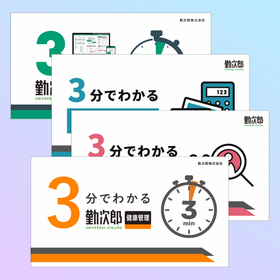
Now available in the '3-Minute Understanding Series'! For those who are a little curious about Universal Kinjirou.
"What kind of system is the Universal Kinjirō series?" "I'd like to get a rough overview of the four systems first." For those who are interested, we have prepared a 【3-minute overview series】 that summarizes the key points of each function in the series. Why not start by checking out a product that piques your interest? We hope you find it useful as a consideration before implementation.
-
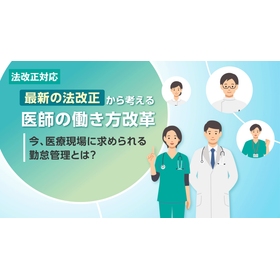
[Useful materials for medical institutions and hospital administrators] now available! A guide for the reform of physicians' work styles and ABC standards, summarizing points for labor management regarding self-improvement and interval regulations.
We are currently publishing a document summarizing important countermeasures for preventing turnover risks in the medical field through "employment × health management"! Please take a look. 【Recommended for】 - Those who want to accurately and reliably manage the upper limits of overtime work according to levels A, B, and C in line with the "work style reform for doctors." - Those who want to implement error notification and alert functions for continuous working hour restrictions and unconfirmed rest intervals. - Those who want to objectively separate and manage the time spent on "self-improvement," which is difficult to judge as working hours, from the actual work content. - Those who want to reduce the hassle of calculating on-call and day duty allowances, manage complex on-call shifts and night shifts, and eliminate aggregation errors. - Those who want to accurately apply a modified working hour system on a monthly or yearly basis while accommodating the unique working systems and complicated shifts specific to hospitals. - Those who want to automate proper labor management in accordance with the rules for on-call and day duty permissions and extract subjects for interview guidance (additional health protection measures) due to excessive labor. - Those who want to centralize employment data and health management data such as stress checks to early detect turnover risks and signs of mental health issues among on-site staff.
-
[Useful Materials for the Transportation and Construction Industries] Now Available! Easy time stamping and work hour management with your smartphone! We will share techniques for utilizing systems that reduce the hassle of complex working hours and on-site aggregation.
● Are you in the logistics, transportation, or construction industry and facing these concerns? [Logistics and Transportation] - After the "2024 issue," I am worried whether we can respond to legal amendments with our monthly summaries... - I want to automatically check the "working hours" and "intervals between shifts" for each driver. - I want to accurately grasp violations of "breaks every 4 hours (to prevent continuous driving)" from operational data. - I want to eliminate the dual management of digital tachograph operational data and attendance management data and link them together. - I want to reduce the hassle of complex payroll calculations, such as overtime pay for hours exceeding 60 per month. [Construction] - I want to accurately track working hours in preparation for the upper limit regulations on overtime (with penalties). - In sites with frequent direct visits and business trips, I want to prove that workers are actually present at the location (objective time stamping). - I want to simplify the management of labor hours spent on "which site, on which task, and for how long." - I want to reduce the administrative burden on management staff related to daily reports and site-specific summaries. - I want to eliminate the hassle of managing alcohol checks and measurement results for company vehicles (white license plates). For those with the above concerns, we explain efficient management methods that comply with industry-specific rules. Please download it!
-
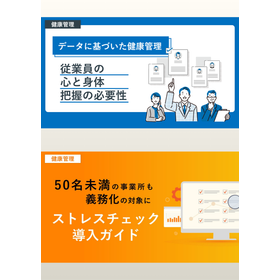
【Mental Health Measures & Stress Check Implementation Useful Materials】 Now Available! How to Prevent Employee Leave and Turnover? A Comprehensive Explanation from Mandatory Compliance to Workplace Improvement.
In recent years, employee mental health issues leading to absenteeism, turnover, and decreased productivity (presenteeism and absenteeism) have become a management risk for companies. The Ministry of Health, Labour and Welfare's guidelines (revised in 2023) require companies to go beyond mere legal compliance and ensure the "effectiveness of workplace environment improvement." It is expected that the obligation for stress checks will be expanded to include workplaces with fewer than 50 employees in the future. Our company is currently publishing materials on "data-driven health management" and "implementation of stress checks." Please utilize them for workplace improvement. ● Recommended for ● - Those who want to prevent employee absenteeism and turnover and improve engagement - Those who want to understand the procedures for implementing stress checks in anticipation of the expansion of obligations to workplaces with fewer than 50 employees - Those who want to prevent management losses caused by presenteeism due to mental health issues - Those who want to ensure that stress checks lead to workplace environment improvements rather than being seen as mere obligations - Those who want to detect employee isolation, which has become less visible due to the increase in telework, at an early stage - Those who want to reduce the administrative burden on HR and general affairs personnel, such as preparing reports for the Labor Standards Inspection Office and collaborating with occupational physicians - Those who want to manage health check and stress check data in a unified manner, integrating it with labor data to enhance health management.